

Christians demand judicial review of pornography law

smaller font larger font print this article email this article to a friend

Published Date: March 16, 2009

More than 1,000 people in a district of Catholic-majority East Nusa Tenggara province have urged public support for judicial review of a controversial pornography law.
8041_1.jpg 
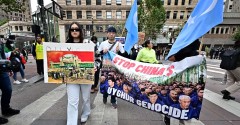
Lawyer Otto Cornelis Kaligis speaking to media after the Constitutional Court hearing

In a statement issued on March 14, these residents of Sikka district, on predominantly Catholic Flores island, urged all social groups to stand behind the review formally requested by a predominantly Protestant district on Sulawesi Island. Lawyers for North Sulawesi´s Minahasa district had filed its legal challenge at the Constitutional Court in Jakarta three days earlier.

Opponents of the anti-pornography law the House of Representatives approved last October, despite strong opposition from several social sectors, charge the law is vague and could be used to restrict many areas of life, including dress, art and cultural expression, especially among minority communities.

“Many citizens worry how much of a negative impact the law might bring about,” said the statement issued at the end of a seminar at Divine Word-run St. Paul Major Seminary in Ledalero, Flores. Its signatories included lay Catholics, priests and seminarians.

According to them, the law contains sectarian ideas that threaten the unity of a diverse nation. Though predominantly Muslim, Indonesia has Hindu, Christian, Confucian and Buddhist minorities as well as followers of local mystical traditions.

Bonifacius Hargens, a speaker at the seminar, told participants the law would be “a means which is used to culturally condition people to placing a limit on certain political values.”

The Catholic lecturer in socio-politics at the Jakarta-based University of Indonesia later pointed out that small pro-Islam parties were behind the law. In his view, the law might inspire the drafting of various local laws and regulations imposing the cultural norms of one community on others.

During the Constitutional Court hearing, lawyer Otto Cornelis Kaligis maintained that the law threatens traditional culture in Minahasa.

It “violates the living constitutional values written in the 1945 Constitution,” he said.

Kaligis cited local dances that could become illegal under the new law. In one of them, angels take a bath on the earth, while in another, boys wear women´s outfits and girls wear men´s. Another local custom likely to be forbidden has men without pants and topless women bathing on the same beach with a wooden or bamboo wall between them.

The lawyer later told the media the law would kill the diversity of cultures in the country. “This law is made with political interests,” he said, calling on people to promote harmony by respecting different cultures.

During the first hearing of the case on Feb. 23, the Constitutional Court directed Minahasa district to amend its lawsuit. This revised suit, presented on March 11, specifically asked the court to review three articles of the law. Article 1(1) defines what pornography is, Article 4(1d) bans production, distribution and other activities related to materials that display nudity, and Article 10 prohibits public performance of pornographic acts.

The legal challenge argues that the law´s definition of pornography is not clear in speaking of “violation against ethical values in the society.” It also questions how artists could survive if they could not sell works that the new law classified as “pornographic” because of nude imagery.

“Article 4(1d) violates the constitutional rights of artisans in Minahasa, since they make a living by selling works of art that explicitly show nudity or nude artistic design,” the district representatives told the court.

After the hearing, Kaligis showed a copy of an article published by “The Jakarta Post” on Feb. 7 on the “latest victim of pornography law.”

“The controversial pornography law has been blasted for targeting cultural heritage, after West Java Governor Ahmad Heryawan used it as a legal basis to forbid Jaipong dancers from wearing ´sexy´ costumes and executing ´provocative´ dance moves,” the article said.

Kaligis added: “We see the dance movements as something beautiful, but the law´s dirty interpretation now makes people have dirty thoughts.”

652 words


Share this article: Share/Save/Bookmark

blog comments powered by Disqus
Advanced Search
Stay in Touch
Subscribe to UCA News free Newsletter
First Name
Last Name
Email
UCAN Photo Gallery